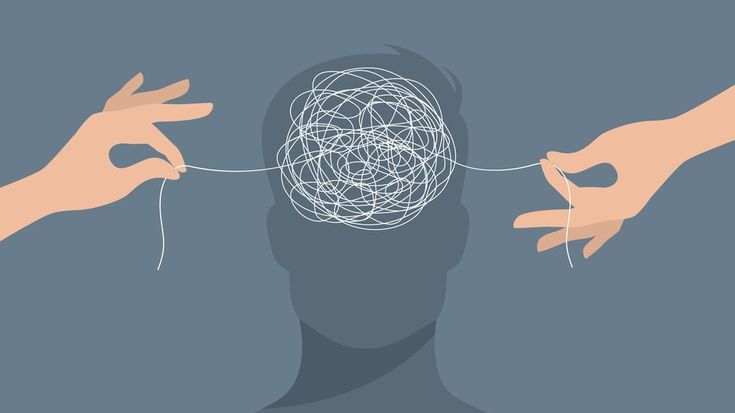
Narcissism isn't just someone being "a little self-centered" or having a bad day it's a complex psychological condition that devastates relationships, fractures families, and leaves lasting scars on everyone in its path., but what actually causes narcissism?
As someone who survived years in a narcissistic marriage, I've witnessed firsthand how this disorder doesn't just affect the narcissist, but creates ripple effects that can destroy partners, children, and entire family systems.But the last question I asked was what causes narcissism?
Understanding what causes narcissism is absolutely critical for survivors. First, it helps you recognize that the abuse you endured wasn't your fault—narcissistic behavior stems from deep-rooted psychological patterns, not from anything you did or didn't do.
Second, knowing what causes narcissism empowers you to break generational cycles, protecting your children and future relationships from similar patterns. Knowing what causes narcissism can open up a whole wormhole of discovery.
Finally, understanding what causes narcissism can fast-track your healing process by providing the clarity and validation you desperately need.
From both scientific research and psychological perspectives, what causes narcissism is multifaceted. It involves childhood trauma, genetics, environmental factors, and societal influences all working together to create these destructive patterns.
If you're trying to learn what causes narcissism and the true origin, be prepared! it's complex work. But breaking down these root causes provides a roadmap for understanding what causes narcissism.
More importantly for survivors and victims, is how to recognize and protect yourself from them in the future. And remember that it’s not your fault no matter how many times your told that by your abuser.
Understanding Narcissism
Definition of Narcissism vs. Narcissistic Personality Disorder (NPD)
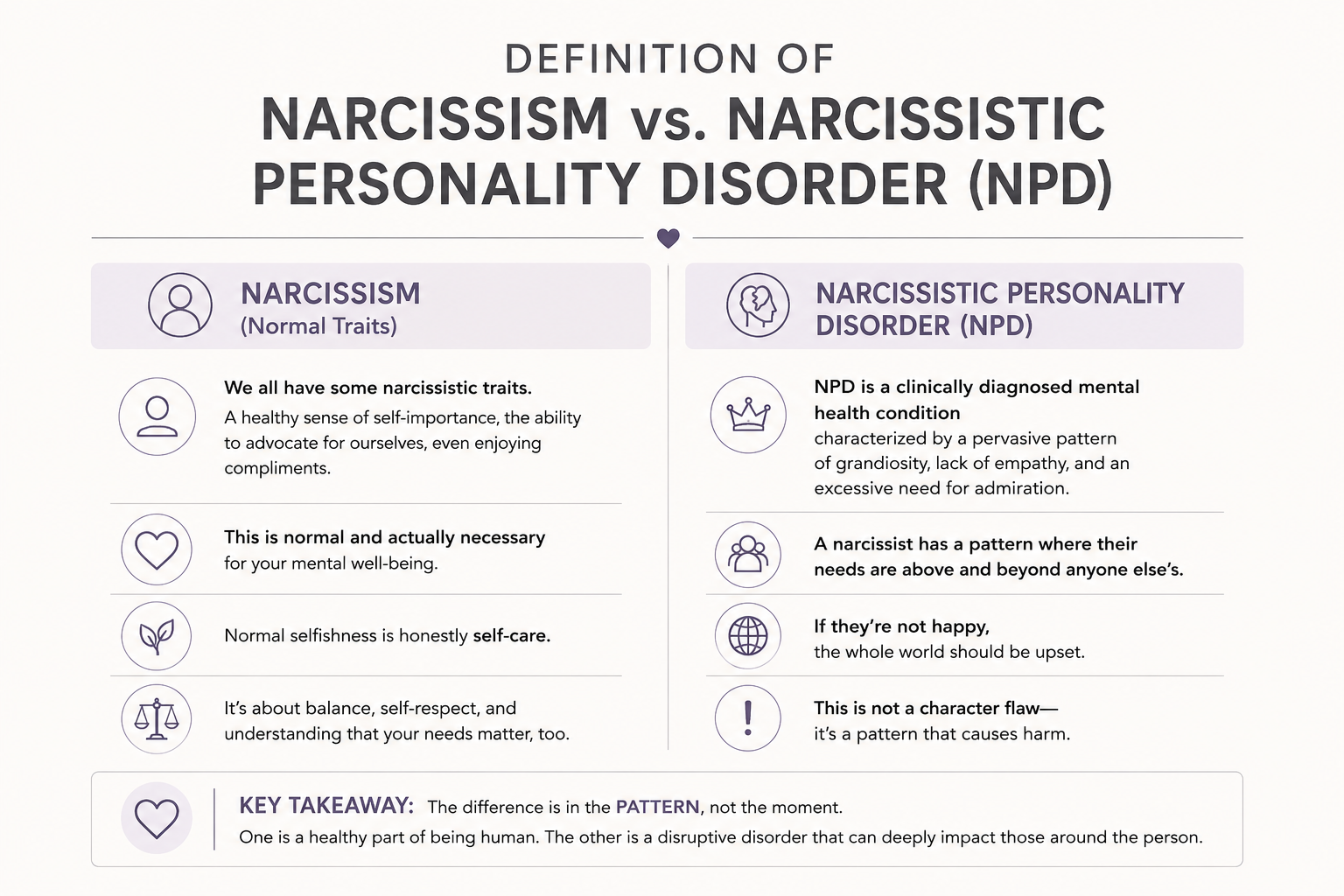
Let's clear up some confusion right from the start. We throw around the word "narcissist" pretty freely these days, but there's a crucial difference between everyday narcissistic traits and full-blown narcissistic personality disorder.
We all have some narcissistic traits, a healthy sense of self-importance, the ability to advocate for ourselves, even enjoying compliments. This is normal and actually necessary for your mental well-being.
Narcissistic Personality Disorder (NPD), however, is an entirely different beast. NPD is a clinically diagnosed mental health condition characterized by a pervasive pattern of grandiosity, lack of empathy, and an excessive need for admiration.
When I lived with my narcissistic ex, the world literally revolved around him. If he wasn't happy, everyone around him would scramble to get him back to a good mood. Looking back now, all I see is a king surrounded by servants and court jesters.
Normal selfishness is honestly self-care. But a narcissist has a pattern where their needs are above and beyond anyone else's. If they're not happy, the whole world should be upset. It's about patterns, not isolated incidents.
Key Characteristics of Narcissistic Behavior
From my experience and research, here are the hallmark traits that separate true narcissistic behavior from healthy self-regard:
Grandiose sense of self-importance - They honestly believe they are superior to everyone else in every way.
Fantasies of unlimited success, brilliance, or power - They live in a fantasy world where they're always the hero of their own story.
Belief they are "special" and unique - They think they're so exceptional that only other special people can understand them. (probably other narcs)
Excessive need for admiration - They need constant validation and praise to function. This is their "supply."
Sense of entitlement - Rules don't apply to them; they deserve special treatment always.
Exploitative behavior - They use people as tools to get what they want without remorse.
Lack of empathy - They cannot or will not recognize others' feelings and needs. I once told my ex how he hurt me, and he honestly said, "I don't care how you feel." And he meant it.
Envy and belief others envy them - Everything is competition, even when it's not.
Arrogant behavior and attitudes - Condescending, dismissive, and superior in all situations.

Common Misconceptions About Narcissism
After surviving narcissistic abuse and helping other women recognize these patterns, I've encountered dangerous misconceptions that keep people trapped:
Misconception #1: "Narcissists are always obvious"
Reality: Many narcissists are charming and charismatic, especially initially. They're master manipulators who know exactly how to present their best face in public, then show their true colors in private.
Misconception #2: "If they show vulnerability, they can't be narcissistic"
Reality: Narcissists can cry, appear vulnerable, and seem genuinely remorseful. They're manipulation masters with acting skills that surpass Hollywood's finest.
Misconception #3: "You can fix or change a narcissist with enough love"
Reality: NPD is a personality disorder requiring professional intervention. Your love, patience, or perfect behavior cannot cure someone else's mental health condition, and can destroy your own in the process.
Psychological and Emotional Factors Behind What-Causes-Narcissism
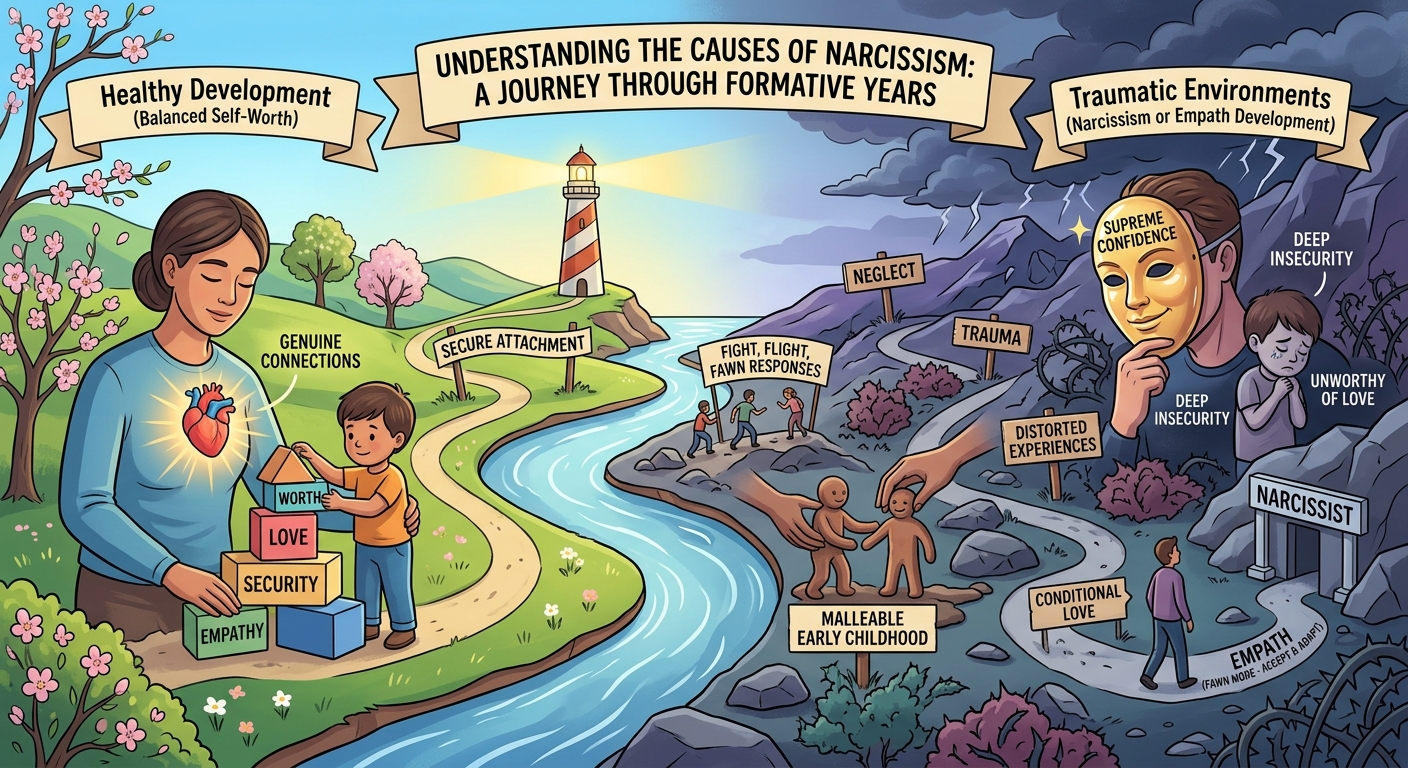
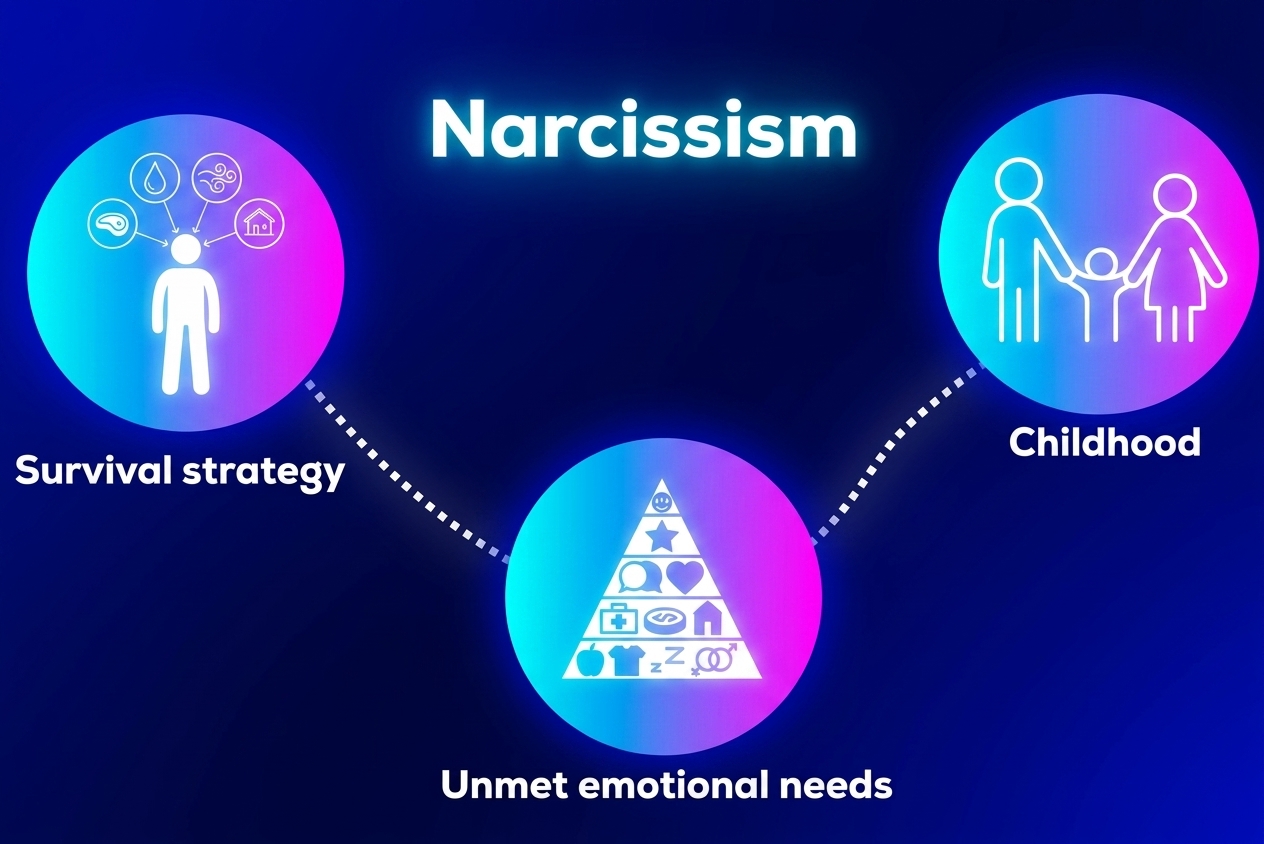
Understanding what causes narcissism requires looking back to their childhood and the crucial formative years. As someone who spent years trying to understand what causes narcissism and how to fix it. It doesn't just appear out of nowhere.
There were signs I just didn't see until I found the pattern and traced it back. And I also had to learn what narcissism is and what causes narcissism.
In early childhood, we're like clay in those first few years of life, malleable, impressionable, and shaped by every interaction with our caregivers. During this critical period, children learn fundamental lessons about their worth, their place in the world, and how relationships work.
If these early experiences are healthy, children develop balanced self-worth and the ability to form genuine connections. But when childhood experiences are traumatic, neglectful, or distorted, they can create either a narcissist or an empath.
The child's developing brain adapts to survive their environment, often creating fight, flight, or fawn responses.
What looks like supreme confidence in an adult narcissist often masks the deep insecurity of a child who never learned they were inherently worthy of love. Their victims have usually been brought up in fawn mode, we accept and adapt.
The Role of Emotional Neglect and Abuse
Emotional neglect and abuse create particularly toxic breeding grounds for narcissistic development.
When children experience consistent emotional invalidation, criticism, or outright abuse, they often develop a "false self." The narcissist learns early that their emotions and needs are either dangerous to express or simply don't matter. So they create this grandiose, superior facade to hide the pain.
The constant need for admiration isn't really about ego, it's about filling a bottomless pit of childhood wounds. Unfortunately, that pit is truly bottomless; there will never be enough validation for them.
Children who grow up walking on eggshells, constantly criticized, or made responsible for their parents' emotions often develop narcissistic traits as survival mechanisms. They learn to manipulate situations to avoid getting hurt and to constantly present a false front of perfection.
How Overindulgence Creates Narcissism
Here's where it gets tricky: narcissism can also develop from the opposite extreme. When children are constantly told they're perfect without having to earn it through genuine effort or character development, they never learn realistic self-assessment or empathy for others.
These children struggle when they encounter real-world situations where they're not automatically the center of attention. They've been conditioned to expect praise and attention, so when they don't receive it, they don't know how to respond appropriately.
Attachment Theory and Narcissistic Development
Attachment theory provides crucial insight into how narcissistic patterns develop. Healthy attachment forms when caregivers are consistently responsive and emotionally available. Children learn that relationships are safe and they can trust others.
Disorganized attachment occurs when children experience inconsistent caregiving or caregivers who use them to meet their own emotional needs. These children learn that relationships are unpredictable, so they must protect themselves and never let anyone truly in.
The tragic irony is that narcissistic behavior, which developed as protection against abandonment, actually creates the very isolation they're trying to prevent.
Genetic and Biological Factors Behind Narcissism
While childhood experiences play a massive role, there's another piece many survivors don't understand, the biological and genetic factors that can predispose someone to narcissistic traits. I wish I'd understood earlier that some aspects of narcissism might literally be wired into the brain.
Is Narcissism Inherited?
Research suggests narcissistic traits have a heritability rate of about 40-60%, meaning genetics account for roughly half the contributing factors. There's no single "narcissism gene", it's much more complex.
Certain temperamental traits that contribute to narcissism tend to run in families: low empathy, high impulsivity, emotional dysregulation, and difficulty with emotional bonding.
If you've ever looked at your narcissistic ex's family and thought, "Now I see where this comes from," you might have been picking up on inherited patterns.
Brain Structure Differences
Brain imaging studies show people with narcissistic traits often have structural differences in key brain areas, particularly regions responsible for empathy, emotional regulation, and self-awareness.
The prefrontal cortex, responsible for impulse control and considering consequences, often shows reduced activity. This might explain why narcissists seem incapable of learning from mistakes, their brain's "stop" is broken.
The amygdala, the brain's threat-detection system, functions differently too. It's often hyperactive, meaning they're constantly scanning for perceived threats not to them but to their ego.
This biological hypersensitivity might explain explosive reactions to minor criticism—their brain interprets it like you are pointing a loaded gun at their head when all you did was say the word No.
Neurotransmitters and Hormones
Brain chemicals play crucial roles in shaping personality. Dopamine works differently in narcissistic individuals—they need more intense stimulation to feel satisfied, also why addiction is prevalent.
Serotonin imbalances contribute to mood swings and poor emotional regulation. Oxytocin, the "bonding hormone," functions poorly, making genuine emotional connections difficult.
Understanding these biological factors helps you stop blaming yourself.
You were dealing with someone whose brain is unable to process emotions and relationships, like anyone else. And unfortunately if you stay with this person your perception can also be affected
Environmental and Social Influences on Narcissism

Parenting Styles That Contribute to Narcissism
Different parenting styles can contribute to narcissistic development:
Authoritarian parenting creates children who either rebel completely or become people-pleasers who later develop narcissistic traits as protection.
Neglectful parenting leaves children to raise themselves, often leading to grandiose fantasies as coping mechanisms.
Permissive parenting without boundaries can create entitled individuals who never learn that actions have consequences.
Cultural and Societal Factors
Our modern society practically breeds narcissistic traits. Social media creates platforms for constant validation-seeking and comparison. Fame culture teaches us that being special and unique is the ultimate goal.
Materialism suggests our worth comes from what we own rather than who we are. I mean it’s everyone's dream to be rich and famous. The narcissist just believes they are that person already.
Impact of Childhood Experiences
Childhood bullying can create narcissistic defenses—if you can't be loved, at least you can be feared or admired. Extreme competition in academics or sports can teach children that their worth depends entirely on being better than others.
Rejection or abandonment can create desperate needs for control and admiration. If the child was always left out and didn’t have a healthy social life, how will they know how to have friends as an adult?
Trauma and Its Link to Narcissistic Traits
What Trauma Causes Narcissism?
Not all trauma creates narcissists, but certain types of childhood trauma are strongly linked to narcissistic development:
Emotional abuse and invalidation
Physical or sexual abuse
Witnessing domestic violence
Parental substance abuse or mental illness
Chronic neglect or abandonment
How Trauma Creates Narcissistic Defenses
Trauma essentially fractures a child's sense of self. To survive, they create elaborate defense mechanisms. The grandiose false self becomes a shield against further hurt.
The lack of empathy protects them from feeling others' pain when they already don’t know how to handle their own feelings; they can’t handle someone else's.
Connection to PTSD and Complex Trauma
Many narcissists actually suffer from complex PTSD, though they'd never admit it. Their hypervigilance, emotional dysregulation, and relationship difficulties mirror trauma responses. The difference is that instead of withdrawing, they've learned to attack first.
Understanding this doesn't excuse their behavior, but it explains why traditional relationship advice fails. You can't reason with someone who's mind and nervous system is constantly in survival mode. It’s like telling someone not to panic in an earthquake.
The Role of Ego and Self-Esteem in Narcissistic Development

The Paradox of Narcissistic Self-Esteem
Here's the biggest misconception about narcissists: people think they have high self-esteem. The truth is exactly the opposite. Beneath that grandiose exterior lies incredibly fragile self-worth. Their entire identity depends on external validation because they have no internal sense of value.
This is why criticism devastates them so completely. When your entire sense of self depends on being perfect and superior and what others think of you, any challenge to that image feels like someone just took away everything you ever accomplished in life.
Defense Mechanisms
Narcissists employ numerous defense mechanisms to protect their fragile egos:
Projection - They accuse others of their own behaviors
Gaslighting - They distort reality to maintain their narrative
Splitting - People are either all good or all bad
Denial - They refuse to acknowledge uncomfortable truths
Rage - They attack when their ego is threatened
These aren't conscious choices, they're automatic responses developed in childhood to survive emotional threats.
Can Narcissism Be Prevented or Treated?

Early Intervention Strategies
Prevention is always better than treatment. But professional help can provide both prevention and treatment for children showing narcissistic traits. Proven strategies include:
Provide consistent, empathetic parenting
Set appropriate boundaries with natural consequences
Teach emotional regulation skills
Model healthy relationships and empathy
Address any underlying trauma immediately
Treatment Effectiveness
Traditional therapy often fails with narcissists because they don't believe they need help. However, some approaches show promise:
Dialectical Behavior Therapy (DBT) teaches emotional regulation skills
Schema Therapy which addresses underlying childhood wounds
Trauma-informed therapy can help those willing to face their past
The biggest challenge is that narcissists rarely seek treatment voluntarily, and when they do, they often try to manipulate the therapeutic process, thereby noting getting an effective outcome.
Can Narcissists Really Change?
This is the question every survivor asks. The honest answer is: rarely, and only with intensive, long-term therapy and genuine motivation to change. The problem is that change requires admitting there's a problem, which threatens their entire identity.
Even when narcissists do change, it's typically surface-level behavioral modifications rather than deep personality transformation. The underlying patterns usually remain. This is their gaslighting skills at work, usually dazzling in a little future faking.

Final Thoughts
Understanding what causes narcissism can be validating, because it confirms what so many survivors already know in their bones: this wasn’t a “communication issue,” a “rough patch,” or something you could have fixed by being more patient, quieter, prettier, or easier to love. Narcissism is shaped by a complex mix of childhood experiences, trauma, attachment wounds, biology, and environment and none of that is your responsibility to carry.
But here’s the line that sets survivors free: understanding the cause is not the same as excusing the harm. You can have compassion for someone’s origin story and still choose boundaries, distance, or leaving. You are allowed to protect your peace even if they never admit what they did.
If you’re still asking, “Was it really that bad?” or “Why do I feel addicted to someone who hurt me?” that’s not weakness. That’s conditioning, trauma bonding, and nervous-system survival. And the good news is: you can heal, you can rebuild self-trust, and you can learn how to spot these patterns early so you never repeat the cycle.
Ready for your next step?
Go to themarymcconnell.com and download my free Narcissistic Abuse Recovery tools (red flags checklist, boundary scripts, and healing resources). Then explore the related articles and programs linked below to keep learning, start your recovery plan, and move forward with clarity.
If this post helped you, share it with someone who’s stuck in the “why” spiral because the right information at the right time can be the beginning of freedom.